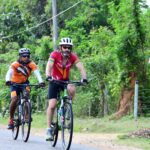
For travellers interested in hiking in Sri Lanka, the Pekoe Trail is changing the way the island’s Hill Country can be explored. Instead of simply travelling between Kandy, Nuwara Eliya and Ella by road or train, you can walk through the landscapes that lie between them — tea estates, villages, forest edges, temples, small communities and working countryside.
The complete Pekoe Trail Sri Lanka extends for roughly 300 kilometres through the Central Highlands, divided into 22 stages that can be walked individually or combined into a longer journey.
And Stage 1 is where it all begins.
Starting in Hanthana, just outside Kandy, and finishing at Galaha, this 13-kilometre walk is an excellent introduction to trekking in Sri Lanka — particularly for travellers who want to experience the Hill Country rather than simply look at it through a vehicle window.
Route: Hanthana to Galaha
Distance: 13.01 km
Typical walking time: Around 3 hours, although we recommend allowing longer if you want to stop and enjoy the journey
Elevation gain: 537 metres
Elevation loss: 470 metres
Highest point: 1,067 metres
Official difficulty: Easy
Starting point: Ceylon Tea Museum, Hanthana
Finishing point: Galaha Post Office
Region: Kandy
The figures tell you about the walk. They don’t really tell you why it is worth doing.
For us, the appeal of Stage 1 lies in how quickly you leave urban Kandy behind and find yourself walking through a very different Sri Lanka.
The trail begins at the Ceylon Tea Museum in Hanthana, housed in a former tea factory.
It is a fitting starting point.
Tea shaped much of the landscape you are about to walk through, as well as the economic and social history of Sri Lanka’s Central Highlands. If your itinerary allows, spending some time at the museum before setting off gives useful context to what you will see during the walk.
From here, the route gradually climbs into the Hanthana Tea Estate.
The transition is remarkably quick. Kandy may be close by, but the atmosphere soon changes to estate roads, tall trees, rolling tea-covered slopes and views across the surrounding hills.
This is one of the reasons we like incorporating walking into a Sri Lanka journey.
A conventional sightseeing itinerary shows you destinations. Walking reveals what exists between them.
The Pekoe Trail isn’t simply a succession of viewpoints.
Stage 1 passes through a landscape where people live and work.
Tea estates are not ornamental gardens created for visitors. They are working landscapes with their own communities, places of worship, homes, roads and routines.
You may see tea workers in the estates, people travelling between villages, children heading to or from school, or somebody stopping at a small roadside shop.
These ordinary encounters are part of the experience.
There is no need to manufacture them.
Don’t rush Stage 1 because the official walking time says three hours.
If the walk forms part of a tailor-made holiday, we prefer to leave room for pauses — a conversation, photographs, a king coconut from a roadside shop or simply sitting somewhere with a view.
Sometimes the best part of a Sri Lanka trek is the part that wasn’t scheduled.
There is also an unexpected piece of film history along this section of the trail.
Parts of the 1984 film Indiana Jones and the Temple of Doom were filmed in Sri Lanka, and Stage 1 passes one of the locations associated with the production.
It feels slightly incongruous among the tea-covered hills — which is precisely what makes it an enjoyable stop.
Rather than treating it simply as another photograph to collect, this is a good place to pause.
A cup of Ceylon tea and a local snack in tea country seems considerably more appropriate.
You do not have to be planning a serious multi-day Sri Lanka trek to enjoy the Pekoe Trail.
That is one of its greatest strengths.
The 22-stage structure means sections of the route can be incorporated into a wider private journey. You might spend a morning walking and continue your journey by vehicle afterwards rather than committing several days exclusively to trekking.
Stage 1 is particularly convenient because it begins close to Kandy.
This makes it possible to combine the walk with a stay in or around Kandy and then continue deeper into the Hill Country.
For travellers researching Sri Lanka walking holidays, this flexibility is important. The choice isn’t simply between doing no walking and spending two weeks trekking.
A good itinerary can combine walking with wildlife, culture, food, rail journeys and characterful places to stay.
Absolutely not.
Completing the entire trail would be a wonderful undertaking for a committed walker, but it isn’t necessarily the best choice for every visitor.
The 22 stages cross different elevations, landscapes and climatic zones and vary in character and difficulty.
For many travellers, selecting several particularly interesting stages and building them into a broader Sri Lanka itinerary makes more sense.
It also means you don’t have to carry your holiday luggage along the trail. Transport can be arranged so that you walk with only what you need for the day while your main luggage continues to your next accommodation.
For a first taste of hiking in Sri Lanka, Stage 1 is an easy place to begin.
The Pekoe Trail Organisation currently classifies Stage 1 as Easy in both directions.
That doesn’t mean it is completely flat.
Over approximately 13 kilometres there is around 537 metres of accumulated elevation gain, and tropical heat or rain can make any walk feel more demanding.
A reasonable level of general fitness is therefore advisable.
Good walking shoes are considerably more important than specialist trekking equipment.
Difficulty ratings are useful, but they should never be the only factor when choosing a Pekoe Trail stage.
Recent rain, temperature, trail conditions, elevation and your own walking experience can all change how demanding a particular section feels.
If walking is an important part of your holiday, choose stages according to you, rather than simply selecting the most famous ones.
There isn’t one perfect month for the entire trail.
Sri Lanka’s Central Highlands contain numerous microclimates, and weather can change quickly with elevation.
According to current Pekoe Trail guidance, the trail can be walked throughout the year, with December to April and July to September generally offering favourable periods, depending on the region and stage.
Even during the better walking months, rain is possible.
That is part of walking in tropical highlands.
Carry a lightweight waterproof layer and sun protection, and keep sufficient drinking water with you. The official trail guidance recommends approximately 1.5–2 litres of water per person.
Starting earlier in the day is also generally more comfortable.
For a single-stage walk, you don’t need an expedition pack.
A small daypack with the essentials is usually sufficient:
Conditions can change quickly in the hills, so being prepared for both sunshine and rain is sensible.
Stage 1 has trail signage and can be navigated using the official Pekoe Trail app.
Independent walkers may therefore be comfortable tackling it themselves.
But navigation isn’t the only reason to walk with a guide.
A good local guide can explain what you are passing: the tea estates, plants, birds, villages, religious sites and small details of daily life that otherwise remain scenery.
For us, that is the difference between walking through Sri Lanka and beginning to understand it.
One of the pleasures of the Pekoe Trail is that much of it passes through living communities and working landscapes.
That also brings responsibilities.
Stay on recognised routes, respect private property, avoid photographing people at close range without permission and take your rubbish with you.
The official Pekoe Trail organisation also asks walkers not to give money directly to children or individuals encountered along the route. Trail passes contribute towards trail maintenance, safety and community development initiatives.
The objective should be simple: leave the landscape and communities you pass through at least as well as you found them.
We think so — but particularly for the right traveller.
If your priority is to see as many headline attractions as possible in a short holiday, a 13-kilometre walk may not be the best use of your limited time.
But if you enjoy walking, landscapes, photography, tea country and unplanned encounters, Stage 1 offers something that conventional sightseeing rarely can.
You start near Kandy.
A few hours later, you have crossed tea estates and hills, passed through working communities and seen a quieter side of the Central Highlands.
The distance isn’t enormous.
The change in perspective can be.
The Pekoe Trail doesn’t need to become your entire holiday.
We can incorporate one stage, several selected stages or a longer section of the trail into a private Sri Lanka journey, arranging the logistics around the walking rather than making the walking fit awkwardly around the logistics.
Your main luggage can travel ahead. A vehicle can meet you where appropriate. Walking days can be balanced with slower days. And the trail can connect naturally with Kandy, tea country, local communities, rail journeys, wildlife areas and other parts of the island.
If trekking in Sri Lanka is one of the reasons you are travelling — but not the only reason — this is often the more rewarding way to experience the Pekoe Trail.
Stage 1 from Hanthana to Galaha is officially 13.01 kilometres long.
The official average duration is approximately three hours. We suggest allowing additional time if you enjoy photography, conversations, refreshments and slower exploration.
It begins at the Ceylon Tea Museum on the Hanthana Estate near Kandy.
The official endpoint is Galaha Post Office.
The Pekoe Trail Organisation classifies the route as Easy, although walkers should still be comfortable covering approximately 13 kilometres with more than 500 metres of accumulated ascent.
No. Individual stages can be walked independently, making the Pekoe Trail particularly easy to incorporate into a wider Sri Lanka holiday.
Yes. Selected stages can be combined with private transport, luggage transfers, accommodation and other experiences, allowing you to create a Sri Lanka walking holiday without spending every day trekking.